


Three Failures of the Past
What are the three failures of the past that led to Pyongyang's nuclear tests? The first one is the failure to recognize that the North's nuclear problem is part and parcel of the interdependence of security concerns. The Bush administration adopted the preemptive strike doctrine in response to the sense of insecurity created after 9-11, but its new strategic posture exacerbated Pyongyang's sense of insecurity(1). Pyongyang sought to restore its security by turning to what it called "nuclear deterrent," but its response ended up exacerbating Washington's proliferation concerns. Their insecurity interdependence is the structural cause of the nuclear problem, and its solution requires a symmetric approach that equitably addresses the insecurity of both parties. Just as much Washington desires its nonproliferation concerns resolved, so does Pyongyang seek its security concerns addressed. One sided solution that fails to simultaneously address the other's concern only exacerbates the situation because it gives all the reason for the undercut party to take countermeasures.
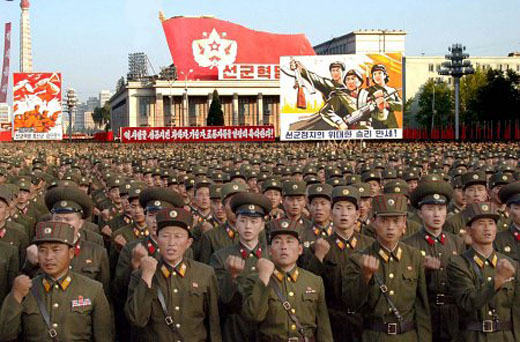
|
| ▲ North Korea troops and civilians staged a mass rally in Pyongyang to celebrate North Korea's 1st nuclear test on october 20, 2006. ⓒYonhap news agency |
The second failure is the failure to acknowledge that it is because they are caught in the state of war that Washington and Pyongyang are concerned about the other's means of violence. Washington does not worry about British nuclear weapons; nor does Pyongyang worry about Chinese weapons(2). It is the state of enmity that is generating the security concerns that Washington and Pyongyang have about each other. Likewise the state of enmity that exists between the two Koreas and between North Korea and Japan is the root cause of the security concerns they have about each other. While it is possible to put in place a temporary stopgap measure that deals with a particular symptom, an enduring solution would have to confront the political cause.
Finally, the third failure is the failure to address the region's power politics that complicates Pyongyang's and Washington's strategic calculations. North Korea, for example, test fired the Taepodong missile in 1998 to signal its displeasure to Washington, but ended up provoking a deep anxiety among Japanese. Washington is deploying and developing missile defense capabilities as a shield against the immediate threat of North Korea's missiles, but its move deepens Chinese suspicion about America's ultimate intention. Not only do Pyongyang and Washington have to input a high degree of uncertainty into their calculations, but their chosen policy also remains susceptible to the whims of other actors unless the regional actors reach stable expectations about one another's goals and policy directions.
Three Structures of Peace
Let's now turn to the future. If these are three critical failures of the past, what would a stable solution look like? It would have to entail at least the following three components that correct the failures.
■ Nuclear Weapons Free Zone
Since one of the causes of the North Korean nuclear problem is the failure to address the insecurity interdependence between the United States and North Korea, a solution must address it. A good way to think about a way to do so is to critically examine the non-nuclear declaration that the North and South signed in 1991. In that declaration, the two parties pledged not to develop nuclear weapons, but no commitment was made by any of the four major powers to respect and support this pledge. This asymmetry, which subjected Korea's non-nuclear survival to the goodwill of its nuclear neighbors', was inherently unstable, and was one of the structural causes of the current "North Korean nuclear crisis." The declaration would have avoided the collapse if it had been made less asymmetric by adding a protocol – which the four nuclear powers would sign and ratify – that they guarantee no introduction, use, or threat of the use of nuclear weapons. A symmetric solution, therefore, has to have two equal parts of denuclearization: both North and South Koreas commit themselves not to engage in nuclear weapons production or related research; and their nuclear neighbors, not to use or threaten to use nuclear weapons against them. The first structure of peace, in short, is a nuclear weapons free Korean peninsula(3).
■ Ending the Enmity
Given the second cause of the "North Korea nuclear problem" is the existence of the enmity between the United States and North Korea, the issue has to be confronted in order to move toward the denuclearization. One of the most stable institutional methods to terminate the enmity would be to end the state of war by a set of simultaneous peace pacts between the parties to the Korean War(4). Washington, Seoul, and Pyongyang can, for example, adopt a set of documents that lay out a comprehensive list of measures, perhaps in a form similar to the Agreed Framework, that each commits itself to taking in order to end the state of war. Seoul and Pyongyang have already made progress on this front – they signed a nonaggression pact in 1991 and a summit statement in 2000 and 2007 – although it remains to be seen whether these agreements can survive the current crisis triggered by the sinking of South Korean naval ship, the Cheonan. Pyongyang and Washington have at various times floated the possibility of a peace treaty, but have yet to take meaningful measures to start the process to end the state of war and normalize their political relationship. The second structure of peace is a peace treaty and the normalization of relations.
■ Regional Architecture of Peace
Finally, the regional nature of the North Korean nuclear problem requires a regional solution, and it would have to be institutionalized in order to provide stability. Such a regional institution may begin as a specific forum exclusively focused on the Korean peninsula, and develop into a region-wide security forum for Northeast Asia. For example, the non-nuclear declaration signed by the two Koreas and endorsed by the four surrounding powers can serve as a basis for building a regional nuclear weapons free zone that includes not only the Korean peninsula but also Japan. The multilateral regional forum may in due course start to address regional security issues such as the potential arms race in Northeast Asia, the looming tension between the United States and China, and the latent fault line between the continental powers of Asia and the maritime powers of the Pacific. As it expands its scope, it may develop into a multilateral common security organization similar to the Organization of Security and Cooperation in Europe (OSCE). The final layer of the peace structure, therefore, is a regional institute of security.
Conclusion: Whither the Korean Peninsula?
Having laid out the three layers of the peace structure, I hasten to add that we should harbor no illusion that the three failures of the past will be overcome over night and the three structures of peace will be built in a day. But the future may not be as bleak as some might imagine, for the present holds seeds of hope. The Obama administration has taken policy positions that resonate well with the three peace structures laid out above: President Obama declared the "world free of nuclear weapons" as a strategic objective; his administration sees diplomacy as "the first line of offense," and Secretary of State Clinton and Special Representative Bosworth have indicated the administration's willingness to discuss ways to terminate the state of war with the North; and President Obama has made a commitment "to build a regional security infrastructure with countries in Asia that can promote stability and prosperity." Pyongyang has, for its part, adopted a policy orientation conducive to the peace structures: its new year's address declared a "peace regime" and the denuclearization as two foreign policy objectives of the year(5) ; its foreign ministry proposed to "start a meeting to replace the armistice with a peace treaty this year(6)" ; and Defense Commission Chairman Kim Jong-Il reiterated, in his meetings with high-ranking Chinese officials, his "country's persistent stance to realize the denuclearization of the Korean peninsula(7)."
If Washington and Pyongyang are pursuing policies that are not only supportive of the peace structures but also harmonious of each other's, why is it then that their current relationship is at its lowest ebb, perhaps even worse than the worst during the Bush administration? One immediate answer lies in the deterioration of the inter-Korean relations for it has tied the hands of the Obama administration that places cooperation with allies as a top priority of its foreign policies.
Another reason has to do with the vicious cycle in which Washington and Pyongyang are caught that is created by the mistrust between them and amplified by the mismatch between their concerns. First, even if they desire the same thing, peace and denuclearization, for example, it is difficult for them to reach the Pareto optimal solution because the lack of trust makes them fear the possibility of the other's defection, as game theories show. The vicious cycle between their mistrust and their failure to cooperate – they fail to cooperate because the mistrust, their mistrust gets hardened because of the failure to cooperate, ad infinitum – gets amplified because Washington and Pyongyang have different priorities. Washington takes non-proliferation as a priority and judges North Korea's behavior against this goal. When Pyongyang launched a rocket in April 2009, thus, it was condemned for undermining the goal by test firing a missile. But to Pyongyang, the condemnation was an affront to Juche, its sense of sovereign independence that it values more than anything else, as well as an attack on Kim Jong-Il's economic recovery program that privileges science and whose success was demonstrated by the "satellite launch." So it vociferously reacted – by conducting a nuclear test in May.
Driven by these competing concerns, Washington and Pyongyang were racing toward a head-on collision, but the collision was avoided by former President Clinton's visit to Pyongyang last August, creating room for creative diplomacy. While there are many issues to sort out, the heart of today's problem is how to sequence denuclearization and peace. Both, of course, are desirable. The question is which one should come first. Washington demands that Pyongyang return to the Six Party Talks and denuclearization first, whereas Pyongyang desires peace talks first. The logger jam over the sequence has the potential to give Pyongyang the time to expand its nuclear capability and put the Six Part Talks into a coma even as Washington, its allies and friends hurt the regime with the continuing sanctions.
The stalemate may be broken by an opportunity provided by any of the multilateral meetings scheduled for the rest of the year. The conference organizers should invite the leader of the United States and North Korea along with those of China and South Korea. There, the leaders can hammer out a series of agreements on denuclearization, peace, and normalization at the highest level possible. The multilateral setting of the conference provides a unique venue where the denuclearization and peace meetings can be held with little difference in the sequence of the meetings. Not only would the multilateral setting raise the profile of the meetings, but it will also increase the international pressure on the participants to abide by the agreements once they make a commitment on the international stage. So why wrangle over the ages old question of whether chicken comes before egg, when we can have both chicken and egg at the same time? It is possible to have both denuclearization and peace. It may well be the only way to have either.
□ Footnote
1. Suh, Jae-Jung. "The Imbalance of Power, the Balance of Asymmetric Terror: Mutual Assured Destruction (MAD) in Korea." In The Future of Us-Korean Relations: The Imbalance of Power, edited by John Feffer, 64-80. London; New York: Routledge, 2006.
2. Wendt makes a similar argument about the Cold War. Wendt, Alexander. 1999. Social Theory of International Politics. New York: Cambridge University Press.
3.John E. Endicott and Alan G. Gorowitz, "Track II Cooperative Regional Security Efforts: Lessons from the Limited Nuclear Weapons-Free Zone for Northeast Asia," Pacifica Review 11, No. 3 (October 1999): 293-324; Peter Hayes and Michael Hamel-Green, "The Path Not Taken, The Way Still Open: Denuclearizing The Korean Peninsula And Northeast Asia," The Asia-Pacific Journal, 50-1-09, December 14, 2009; and Andrew Mack, "A Northeast Asia Nuclear-Free Zone: Problems and Prospects," in Nuclear Policies in Northeast Asia, UNIDIR/95/16 (New York: United Nations, 1995).
4. Who are the parties to the war remains contentious. See for example, Pat Norton, "Ending the Korean Armistice Agreement: The Legal Issues," The Nautilus Institute, Northeast Asia Peace and Security Network, Policy Forum Online, March 1997 (http: //www.nautilus.org/napsnet/fora/2a_armisticelegal_norton.html).
5. Joint Editorial, Rodongsinmun, Chosǒninmin'gun, and Ch'ǒngnyǒnjǒnwi, January 1, 2010.
6. DPRK, Foreign Ministry, January 11, 2010.
7. Herskovitz, Jon. "North Korea's Kim Makes Denuclearisation Pledge." Reuters, February 8, 2010.
| This article is a revised version of a talk Prof.Suh gave at Colin Powell Center for Policy Studies, The City College of New York, New York, NY, on April 23, 2010. |


전체댓글 0