


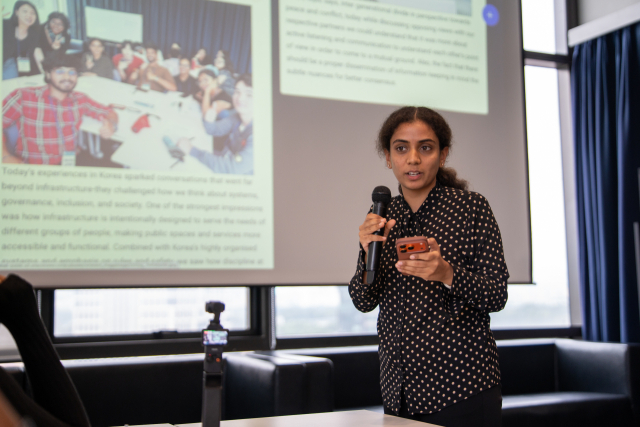
경희대학교 후마니타스칼리지와 실천교육센터는 유네스코 마하트마 간디 지속가능발전 및 평화교육연구소(UNESCO MGIEP)와 공동으로 글로벌 청년 리더 양성 프로그램(UNESCO MGIEP Youth Fellowship: Leadership for Peace and Sustainability)을 7월 2일부터 11일까지 운영했다. 인도의 30세 미만 청년 15명이 세계시민으로서의 역량을 강화하고 복합위기에 처한 현대사회에 대응하기 위해 이번 연수에 참가했다.
세계시민교육, 평화, 지속가능한 발전, 디지털 민주주의, 빈곤과 주거, 이주와 다문화 등의 주제를 중심으로 기조 강연, 워크숍, 현장 탐방 등 다양한 프로그램에 참여한 결과와 한국사회를 바라보는 인도 청년의 기록 5편을 <프레시안>에 기고한다.
나는 2026년 7월 2일부터 11일까지 한국에서 열린 '경희대 후마니타스칼리지 - 유네스코(UNESCO) MGIEP 청년 펠로우십 프로그램(2026)'에 참가하게 된 것을 매우 영광스럽게 생각한다. 평화 구축, 혁신, 청년 리더십에 대해 더 배우고자 하는 기대감으로 한국에 왔지만, 인도로 돌아갈 때 훨씬 더 소중한 교훈을 얻었다. 그것은 사회는 궁극적으로 기술 발전의 수준이 아니라 사회 제도에 내재된 가치와 모든 개인에게 부여된 존엄성에 의해 형성된다는 깊은 깨달음이었다.
이 펠로우십의 가장 두드러진 특징은 이론과 실천을 분리하지 않는 점이다. 간디의 철학, 사회정서학습, 세계시민성, 청년 리더십에 관한 논의가 강의실에 머무는 것이 아니라 다양한 그룹과의 상호작용을 통해 풍부해졌다. 활동가와 정책 입안자, 사회적 기업가, 이주민 공동체, 지방자치단체, 일반 시민들과의 대화를 통해 일상 활동 속에서 포용적인 사회가 실제로 어떻게 구현되는지를 자연스럽게 보여주었다.
펠로우십 기간 동안 가장 인상적이었던 순간 중 하나는 북한 국경에 가장 인접한 민간인 통제구역을 방문한 일이었다. 분쟁의 물리적 흔적은 거의 보이지 않았지만, 국경이 사람들의 기억 속에 여전히 깊이 새겨져 있다는 것을 알게 되었다. 그러나 나에게 깊은 감명을 준 것은 긴장감 그 자체보다는 역사와 희망을 동시에 지키려는 한국의 놀라운 헌신이었다. 이산가족을 위한 추모비, 화해의 상징물, 의도적으로 조성된 기억의 공간들은 고통스러운 역사를 지우기보다 공동의 책임으로 승화시키고자 하는 사회의 노력을 보여주었다. 평화는 망각이 아니라 의도적인 기억을 통해 유지된다는 것을 알게 되었다.
이러한 철학은 펠로우십 기간 내내 지속적으로 드러났다. 현재 민주화운동기념관으로 변모한 옛날 반공 심문소에서는 고통스러운 역사가 민주주의 가치를 지키는 교훈으로 승화되었다. 세월호 참사 이후 설립된 4.16 생명안전교육원에서는 기억이 교육과 책임감으로, 나아가 미래 세대를 보호하기 위한 국가의 약속으로 발전했다. 이러한 경험들은 회복탄력성이란 비극을 회피하는 것이 아니라, 기억이 공적 실천으로 이어지도록 보장함으로써 이루어질 수 있음을 보여주었다.
한국에서 혁신이 어떻게 이해되고 있는지를 직접 목격한 것은 매우 뜻깊은 경험이었다. 펠로우십 이전에는 혁신이란 곧 첨단 기술과 밀접하게 연결된 것이라고 생각하곤 했다. 그러나 성동구를 탐방하며 그 생각이 근본적으로 바뀌었다. 가장 의미 있는 혁신은 기술 자체가 아니라 그 기술을 통해 해결할 수 있는 문제라는 것을 깨닫게 되었다. 스마트 버스정류장 쉼터는 시민들을 악천후로부터 보호할 뿐만 아니라 대중교통 이용을 장려하는 효과를 가져왔다. 응급 대응 시스템은 신속한 조치를 통해 시민들의 신뢰를 높이는 데 기여했다. 학교 주변의 보행자 안전 대책은 사고 발생을 조용히 줄이고 있었다. 이처럼 기술은 단순히 눈길을 끌기 위한 것이 아니라, 일상생활의 질을 향상시키는 데 숨은 역할을 하고 있었다.
인간 중심 철학은 한국의 디지털 민주주의 실현을 위한 사회적협동조합 빠띠(Parti)에서도 뚜렷하게 나타났다. 빠띠가 던진 "공공 광장의 주인은 누구인가?"라는 질문은 민주주의 대화의 방식을 획기적으로 바꾸어 놓았다. 빠띠의 활동은 디지털 플랫폼이 단순한 소통의 매개체를 넘어 대화와 숙의, 그리고 집단적 의사결정을 위한 공간이 될 수 있음을 실증적으로 보여주었다. 시민들의 상호작용이 대부분 사기업의 플랫폼에서 이루어지는 현재 상황에서, 디지털 공간을 민주적 공공재로 인식하는 것은 시의성이 높고도 필수적인 관점이었다. 이와 같은 맥락에서 민주주의는 단순한 주기적 사건이 아니라 일상적인 참여와 실천으로 재해석되었다.
이번 펠로우십은 기존 지역사회 개발에 대한 이해에 변화를 일으켰다. 헤이그라운드의 사회적 기업, 동자동의 협동조합 운동, 안산의 이주민 공동체와 고려인 디아스포라 단체 등을 통해 얻은 일관된 원칙은 지속적인 변화는 공동체를 "위해" 만드는 것이 아니라 "함께" 만들어가는 것이라는 점이다. 참여는 단순히 발전의 결과물이 아니라 그 근본이었다. 규모와 상관없이 모든 계획은 적절한 기회와 제도적 지원이 주어진다면 사람들이 자신 스스로의 미래를 만들어갈 수 있다는 신뢰를 반영하고 있었다.
이와 같은 경험들은 해안 지역 사회와 함께 해조류 양식 및 가공을 통해 지속가능한 삶을 구축하고자 했던 나의 업무와 밀접하게 연결되어 있다. 지역 사회와 협력하면서, 특히 계절에 따라 이동하거나 다른 지역으로 이주해야 하는 어민들이 사회복지제도에 접근하는 데 겪는 어려움을 직접 목격한 바 있다. 펠로우십 기간 동안, 나는 한국의 경험을 인도 상황에 맞는 질문으로 지속적으로 변환하고 있음을 깨달았다. 이는 무엇을 그대로 따라할 수 있을지에 대한 것이 아니라, 어떤 원칙을 적용할 수 있을지에 대한 질문이었다. 그 답은 일관되게 참여적 거버넌스, 포용적인 기술, 그리고 사람들의 삶의 현실을 중심으로 설계된 제도를 가리키고 있었다.
전문적인 관점에서 이 펠로우십은 공공정책에 대한 나의 이해를 프로그램과 실행의 범위를 넘어서까지 확장시켰다. 효과적인 제도는 궁극적으로 신뢰, 참여, 사회적 결속을 바탕으로 형성된다는 점을 다시 인식하게 되었다. 개인적으로, 이는 내가 더 큰 겸손을 배우는 기회를 제공했다. 역사, 투쟁, 열망이 나와는 전혀 다른 공동체들의 이야기를 들으면서, 세계시민성은 단순히 해결책을 제시하는 것이 아니라, 문화와 맥락을 초월하여 경청하려는 의지에서 시작된다는 것을 다시 깨닫게 되었다.
기후 변화, 이주, 기술 혁신, 민주주의의 불확실성이 두드러지는 현대 사회에서 리더십에 관한 논의가 활발히 진행되고 있는 가운데, 한 가지 메시지가 나에게 깊은 여운을 남겼다. 세계가 당면한 문제들은 이제 더 이상 독립적으로 존재하지 않으며, 우리의 대응 또한 고립된 방식으로 이루어질 수 없다. 오늘날 요구되는 리더십은 지역적 상황에 깊이 뿌리를 내리고 있으면서 동시에 다양한 분야와 학문을 넘어 국경을 초월하여 협력할 수 있는 역량을 필요로 한다.
인도에 돌아왔어도 한국에서 그대로 가져온 청사진은 없다. 왜냐하면 모든 사회는 고유한 역사적 배경과 맥락에 의해 형성되기 때문이다. 대신 한국에서 얻은 것은 혁신은 언제나 인간의 존엄성을 강화해야 하며, 민주주의는 참여적인 방식이어야 하고, 발전의 척도는 모든 개인이 소속감을 느끼며 기여하고 번영할 수 있는지에 따라 평가되어야 한다는 확고한 믿음이다.
이번 펠로우십에서 배운 가장 큰 교훈은 아마도 이런 점일 것이다. 진정으로 강한 사회는 단순히 가장 빠른 혁신을 이루거나 가장 빠르게 성장하는 사회가 아니다. 과거를 솔직하게 기억하고, 현재를 공감으로 계획하며, 모든 사람을 고려해 미래를 건설하는 사회다. 이것이 내가 인도의 해안 지역 공동체와 함께 더 포용적이고 지속가능하며 따뜻한 미래를 만들기 위해 꾸준히 실천하고자 하는 교훈이다.
※ 프라니타 풀라마라주(Pranitha Pullamaraju)는 공공정책학 전공자로 안드라프라데시주의 최대 도시인 비사카파트남(비자그)의 해안 지역 주민들의 생계 강화에 주력하는 스타트업 기업가이다.
Beyond Innovation: What it truly takes to build a society that cares
From the 2nd to the 11th of July 2026, I had the privilege of participating in the UNESCO Mahatma Gandhi Institute of Education for Peace and Sustainable Development Youth Leadership for Peace and Sustainability Fellowship in South Korea. I arrived expecting to learn more about peacebuilding, innovation, and youth leadership. I returned with something far more enduring: a deeper understanding that societies are ultimately shaped not by the sophistication of their technology, but by the values embedded within their institutions and the dignity they extend to every individual.
What distinguished this Fellowship was its refusal to separate ideas from reality. Discussions on Gandhian philosophy, social-emotional learning, global citizenship, and youth leadership were not confined to classrooms. They unfolded through conversations with activists, policymakers, social entrepreneurs, migrant communities, local governments, and ordinary citizens whose everyday work quietly demonstrated what inclusive societies look like in practice.
One of the most powerful moments came during our visit to the Civilian Control Zone closer to the North Korean border. Looking across a landscape where the physical signs of conflict were almost invisible, it became apparent that some borders continue to exist most profoundly in human memory. Yet what stayed with me was not the tension itself but Korea's remarkable commitment to preserving hope alongside history. Memorials to separated families, symbols of reconciliation, and spaces intentionally created for remembrance reflected a society that has chosen not to erase difficult chapters, but to transform them into collective responsibility. Peace, I realised, is not sustained through forgetting; it is sustained through remembering with purpose.
That philosophy surfaced repeatedly throughout the Fellowship. At the former anti-communist interrogation centre, now transformed into the National Museum of Korean Democracy, painful histories had become lessons in protecting democratic values. At the 4.16 Life and Safety Education Centre, established after the Sewol Ferry disaster, remembrance had evolved into education, accountability, and a national commitment to safeguarding future generations. These experiences demonstrated that resilience is built not by avoiding tragedy, but by ensuring that memory informs public action.
Equally transformative was witnessing how innovation was understood in South Korea. Before the Fellowship, I often associated innovation with advanced technology. Our visit to Seongdong-gu fundamentally challenged that assumption. The most meaningful innovations were not the technologies themselves, but the problems they were designed to solve. Smart shelters protected citizens from extreme weather while encouraging public transport use. Emergency response systems strengthened public trust through rapid action. Pedestrian safety measures quietly reduced accidents near schools. Technology was not showcased for its novelty; it worked almost invisibly to improve everyday life.
That same human-centred philosophy was evident during our engagement with Parti, a digital democracy and civic dialogue cooperative in South Korea, where one simple question framed an entire conversation on democracy: Who owns the public square? Their work demonstrated that digital platforms could become spaces for dialogue, deliberation, and collective decision-making rather than merely channels for communication. At a time when much of our civic interaction takes place on privately owned platforms, the idea of digital public spaces as a shared democratic commons felt both timely and necessary. Democracy, in this context, was not viewed as a periodic event but as an everyday practice of participation.
The Fellowship also challenged conventional understandings of community development. Whether through social enterprises at HEYGROUND, the cooperative movement in Dongja-dong, or the intercultural initiatives in Ansan supporting migrant communities and the Koryo-saram diaspora, one consistent principle emerged: lasting change is created “with” communities, never “for” them. Participation was not treated as an outcome of development; it was its very foundation. Every initiative, regardless of scale, reflected trust in people's ability to shape their own futures when provided with the right opportunities and institutional support.
These experiences resonated deeply with my own work, where, alongside fisherfolk and coastal communities, I work towards building sustainable livelihoods through seaweed cultivation and processing. While working with these communities, I have witnessed firsthand the barriers many fisherfolk face in accessing social welfare schemes, particularly when they migrate seasonally or across states in search of work. Throughout the Fellowship, I found myself constantly translating South Korean experiences into questions relevant to the Indian context: not asking what could be replicated, but what principles could be adapted. The answer consistently pointed towards governance that is participatory, technology that is inclusive, and institutions that are designed around the lived realities of people.
Professionally, this Fellowship has expanded my understanding of Public Policy beyond programmes and implementation. It has reinforced that effective institutions are ultimately built on trust, participation, and social cohesion. Personally, it cultivated greater humility. Listening to communities whose histories, struggles, and aspirations differed so profoundly from my own was a reminder that global citizenship begins not with having solutions, but with the willingness to listen across cultures and contexts.
As discussions turned towards leadership in an age defined by climate change, migration, technological disruption, and democratic uncertainty, one message remained with me. The world's challenges no longer exist in isolation, and neither can our responses. Leadership today demands the ability to work across disciplines, sectors, and borders while remaining deeply rooted in local realities.
Back in India, I do not carry a blueprint copied from South Korea. Every society is shaped by its own history and context. What I have carried back instead is a renewed conviction that innovation must always deepen human dignity, that democracy must remain participatory, and that development must ultimately be measured by the extent to which every individual can belong, contribute, and thrive.
That, perhaps, was the Fellowship's greatest lesson. The strongest societies are not simply those that innovate the fastest or grow the quickest. They are the ones who remember their past with honesty, design their present with empathy, and build their future with everyone in mind. Those are lessons I hope to carry forward in my work with the coastal communities in India and in every effort to build a more inclusive, sustainable, and compassionate future.
※ Pranitha Pullamaraju is a Public Policy graduate and a startup entrepreneur focused on strengthening coastal livelihoods in Visakhapatnam, Andhra Pradesh.


전체댓글 0